This lesson is about the oceans and continents: large blue areas and colorful shapes that seem to float on them. The blue areas are the oceans, and the colored shapes are the continents. Together, they make up the surface of our planet and divide it into land and water.
Oceans and Continents
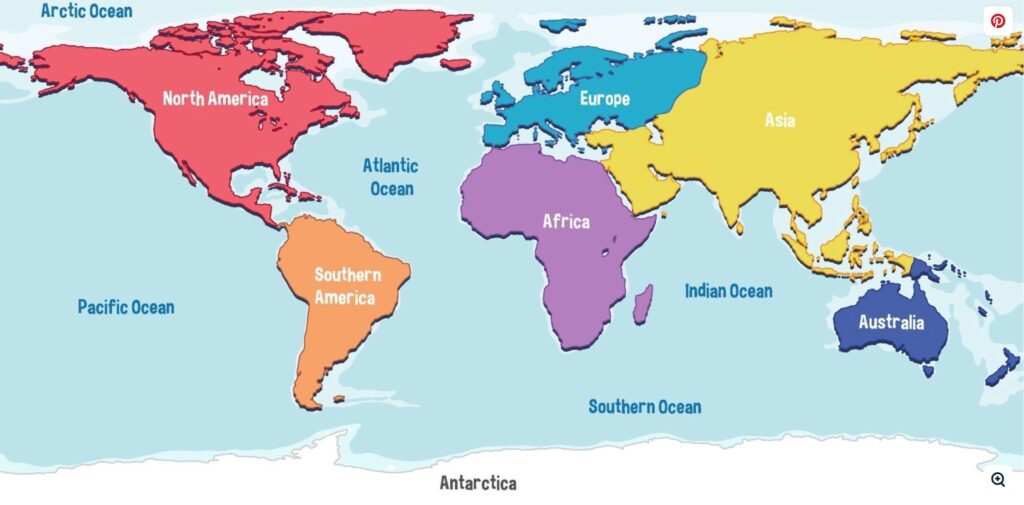
Seen from space, the main color of the Earth is blue. Oceans and seas cover about 71% of the planet’s surface.
The Oceans
There are 5 oceans on Earth:
- The Pacific Ocean
- The Atlantic Ocean
- The Indian Ocean
- The Arctic Ocean
- The Southern (or Antarctic) Ocean
The Pacific Ocean is the largest, with more than 155 million square kilometers. The Arctic Ocean is the smallest, with a little more than 14 million square kilometers.
The Continents
In English-speaking countries, we usually name 7 continents:
- Europe
- Asia
- Africa
- North America
- South America
- Oceania (or Australia and Oceania)
- Antarctica
Continents cover about one quarter of the Earth’s surface. Most continents are in the Northern Hemisphere. Asia is the largest continent (about 44 million km²). Europe and Oceania are smaller continents, with about 10 and 9 million km².
Geographic vocabulary about oceans and continents
Oceans and continents : focus on the oceans
| Ocean | Where is it? (continents) | Main idea for students | Size / depth (order of magnitude) |
|---|---|---|---|
| Pacific | Between Asia and Oceania to the west, and the Americas to the east | The largest ocean in the world, very deep | About 155–170 million km², deepest point close to 11 000 m (Mariana Trench) |
| Atlantic | Between the Americas to the west and Europe–Africa to the east | Separates the “Old World” (Europe–Africa) and the “New World” (Americas) | Second largest ocean, major shipping routes between Europe, Africa and the Americas |
| Indian | Between Africa, Asia (India) and Australia | Ocean with mostly warm, tropical waters | Third largest ocean, average depth around 3 700 m |
| Arctic | Around the North Pole, bordered by North America, Europe and Asia | Smallest ocean, largely covered with sea ice | Very cold, sea ice for most of the year |
| Southern (Antarctic) | Around the continent of Antarctica, south of the other oceans | Surrounds Antarctica, plays an important role in global climate | Very cold ocean, strong storms and powerful currents |
Oceans and continents : focus on the continents
| Continent | Where is it? (hemispheres, landmarks) | Main idea for students | Approx. area / population |
|---|---|---|---|
| Africa | South of Europe, between the Atlantic Ocean and the Indian Ocean | Second largest continent, very populated and very diverse | ≈ 30 million km², about 1.5 billion people |
| North America | In the north‑west, mostly in the Northern Hemisphere, between the Pacific and Atlantic Oceans | Continent of the United States, Canada and Mexico | ≈ 21 million km², about 600 million people |
| South America | South of North America, largely in the Southern Hemisphere | Continent of the Amazon rainforest and many Spanish‑speaking countries | ≈ 17–18 million km², about 440 million people |
| Europe | West of Asia, north of Africa | Continent where France is located, highly urbanized | ≈ 10 million km², about 740 million people |
| Asia | East of Europe, from the Arctic Ocean to the Indian Ocean | The largest and most populated continent | ≈ 44 million km², about 4.7 billion people |
| Oceania | Mostly in the Southern Hemisphere and the Pacific Ocean (Australia, New Zealand, many islands) | Continent made of many islands and the large island of Australia | ≈ 9 million km², about 40 million people |
| Antarctica | Around the South Pole, surrounded by the Southern Ocean | Frozen continent, no permanent population | ≈ 14 million km², almost no permanent inhabitants |
Quiz – Oceans and Continents (5th Grade)
1. What is a continent?
2. How many continents do we usually name in English?
3. Which continent includes countries like France, Germany and Spain?
4. Which continent is almost completely covered with ice?
5. What is an ocean?
6. How many main oceans do we usually distinguish?
7. Which is the largest ocean in the world?
8. Mainland France is located on the continent … and is bordered by the ocean …
9. Which of these groups is correct?
10. Which sentence is true?
Skills related to oceans and continents (5th Grade)
| Skill : oceans and continents | Indicator of success : oceans and continents |
|---|---|
| Name the continents and oceans | The student can name the 7 continents and the 5 main oceans. |
| Locate continents on a world map | The student can place or find each continent on a world map or globe. |
| Locate oceans on a world map | The student can place or find the main oceans between the continents. |
| Distinguish continent, country, ocean, sea | The student explains that a continent is a large area of land, a country is part of a continent, an ocean is a huge body of salty water and a sea is smaller than an ocean. |
| Use oceans and continents as reference points | The student describes the position of a place using continents and oceans (for example: “France is in Europe, bordered by the Atlantic Ocean”). oceans and continents |